
Red Sea Is Back on Suez — So Why Didn't Europe Rates Collapse?
Red Sea Is Back on Suez — So Why Didn't Europe Rates Collapse?
Executive Summary
Four Red Sea services are back through the Suez Canal, yet Europe spot rates barely moved this week. That isn't a contradiction — it's your window. If you're holding cargo for Europe or the Mediterranean, the loose capacity you've been waiting for is open right now, and it won't stay open long. South America and the US lanes are moving the other way, so the clock is running on two fronts at once.
| South America (Santos) | +14.1% → $7,119 / TEU |
| Persian Gulf (Dubai) | +3.1% → $5,422 / TEU |
| US West Coast | +3.5% → $6,714 / FEU |
| US East Coast | +3.0% → $9,566 / FEU |
| Southeast Asia (Singapore) | −1.9% → $671 / TEU |
| Europe (base port) | −0.6% → $2,945 / TEU |
| Mediterranean | −2.9% → $3,929 / TEU |
| SCFI index (14 Aug) | 3,355.24 points (+79) |
| Blank sailings, 17 Aug–20 Sep | 49 sailings (7% cancelled) |
| Europe / Med spot this week | $4,100–4,450 / FEU |
Overview
Start with the week's numbers. The SCFI printed 3,355.24 points on 14 August — up 79 points from the week before. Don't read that red index as a market-wide boom. It has already split in two.
Your core lanes are the ones climbing. South America (Santos) jumped 14.1% in a single week to $7,119 per TEU. The Persian Gulf (Dubai) followed, up 3.1% to $5,422. US West is at $6,714 per FEU and US East at $9,566, both still creeping up. Southeast Asia (Singapore) slipped 1.9% to $671.
Your other core lanes fell. Europe base ports sat at $2,945 per TEU, down 0.6%. The Mediterranean eased 2.9% to $3,929. Inside one trade, some shippers grab space while others dump boxes — so don't fixate on those 79 index points this week.
Don't be fooled by the 79 points.
Key Details
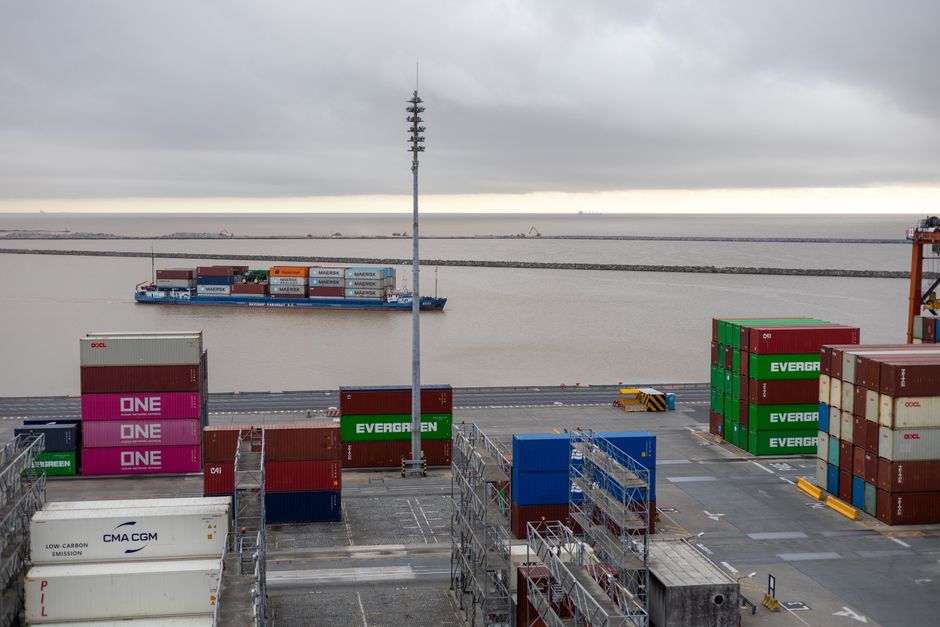
The number to watch this week isn't up or down. It's the Red Sea. Maersk and Hapag-Lloyd (the Gemini Alliance) said on 10 August that their AE19 service would drop the Cape of Good Hope routing and go back through Suez, starting with the Berlin Maersk 628W/637E sailing and expected to transit the canal around 8 September. Add the AE15, MECL and WAF6 services that already returned, and four Red Sea–Suez loops are now back — covering roughly a third of normal transit volume.
By the old logic, a capacity release like that should have smashed Europe rates. Instead Europe dipped just 0.6% this week. My read is that this return is gradual rather than a one-time flood, the Europe rate floor will sit above the diversion-era norm, yet the marginal capacity is genuinely loosening and that is what should shape your next booking decision. Don't mistake it for "the Red Sea crisis is over" — ships are still diverting, and the risk never left.
The first sailing to actually transit Suez is the Berlin Maersk 628W, around 8 September. Until that box clears the canal, treat every "Red Sea is back" headline as noise, not as a signal to delay your Europe cargo.
Haitong Futures reads it the same way: the restart has moved from trial-by-single-sailing to systematic rollout, but every other east–west lane still rounds the Cape, with no timetable for a full return.
Europe didn't really crash. Don't treat that as nothing, either.
Looking Ahead
Here's the action. Europe and Mediterranean spot rates are drifting down this week, sitting around $4,100–4,450 per FEU, and carriers are still cutting their late-August quotes. My advice: consolidate your Europe and Med cargo and ship it now — don't wait. This is the rare soft window inside the diversion era, and it closes the moment the capacity math flips.
The South America trade moves the opposite way. Santos is already at $7,119, so if that box is going, lock space this week — the longer you sit, the more it costs. And watch your US quotes: from September, Asia-to-US-East-and-Gulf sailings pick up a Panama Canal surcharge. Build it into any post-September US East rate you quote, or it eats your margin. Lock Santos before it moves again — send us your routing and we'll hold the space.
Between 17 August and 20 September — five weeks — the east–west mainlines are set to blank 49 sailings, a 7% cancellation rate. Capacity is pulling in while demand hasn't spiked, and that's the only reason rates are holding where they are.
Market Outlook
My read for the next 30 days: the Europe window is real but thin. The four Suez loops won't flood capacity overnight — Gemini's own schedule shows a phased return, and the rest of the network is still on the Cape — so don't bank on a rate collapse; bank on a few weeks of breathing room you can actually use.
Frankly, the bigger risk for your quote isn't Europe falling. It's South America and the US lanes running hot while you wait. Santos at $7,119 isn't the peak yet; the seasonal climb usually tops out higher, and that Panama surcharge from September is non-negotiable on US East — quote it in from day one.
Bottom line for your bookings: push Europe and Med volume into the 17 August–20 September window, lock Santos space before it moves again, and send us your sailing dates so we can pair your box with a loop that's actually transiting Suez — not one still going around Africa.
JETWAY Supply Chain is your execution partner on the ground in China — based in Tianjin, licensed as an NVOCC (MOT) and a member of CIFA, FIATA and WCA. We run ocean, air, rail and road across the corridors that matter to you — China–India–Red Sea, China–South America and Southeast Asia — and we pre-check your documents before the box is stuffed so your filing clears the first time. See our services. Request a quote and tell us your sailing window; we'll tell you which loop is actually on Suez this week.